See the story
One documented UK case at a time, recreated to reflect how it appeared in its original information environment.
A facilitated learning experience from KernVect
Nine real UK cases. Some were false. Some were true. Amplified helps a group explore how stories spread, why they can feel convincing and what to check before passing them on.
The aim is not to teach people to distrust everything. It is to help them become more confident in working things out for themselves.
Bots can light the match. People pass it on. People can stop it too.
Misleading information often moves through ordinary conversations and community spaces. Amplified gives people a chance to pause, make a decision and look at the evidence together, without being judged for getting something wrong.
The experience
Participants make their own decision before the evidence is revealed. The group then explores what happened, how each story travelled and what could have been checked.
One documented UK case at a time, recreated to reflect how it appeared in its original information environment.
Choose whether you would share it, check first or scroll past. There is no pressure to get every answer right.
Room mode lets a facilitator gather a show of hands and record the group's choices before revealing the case.
See what happened, how the story spread, the techniques involved, how it could have been checked and links to the evidence.
See it
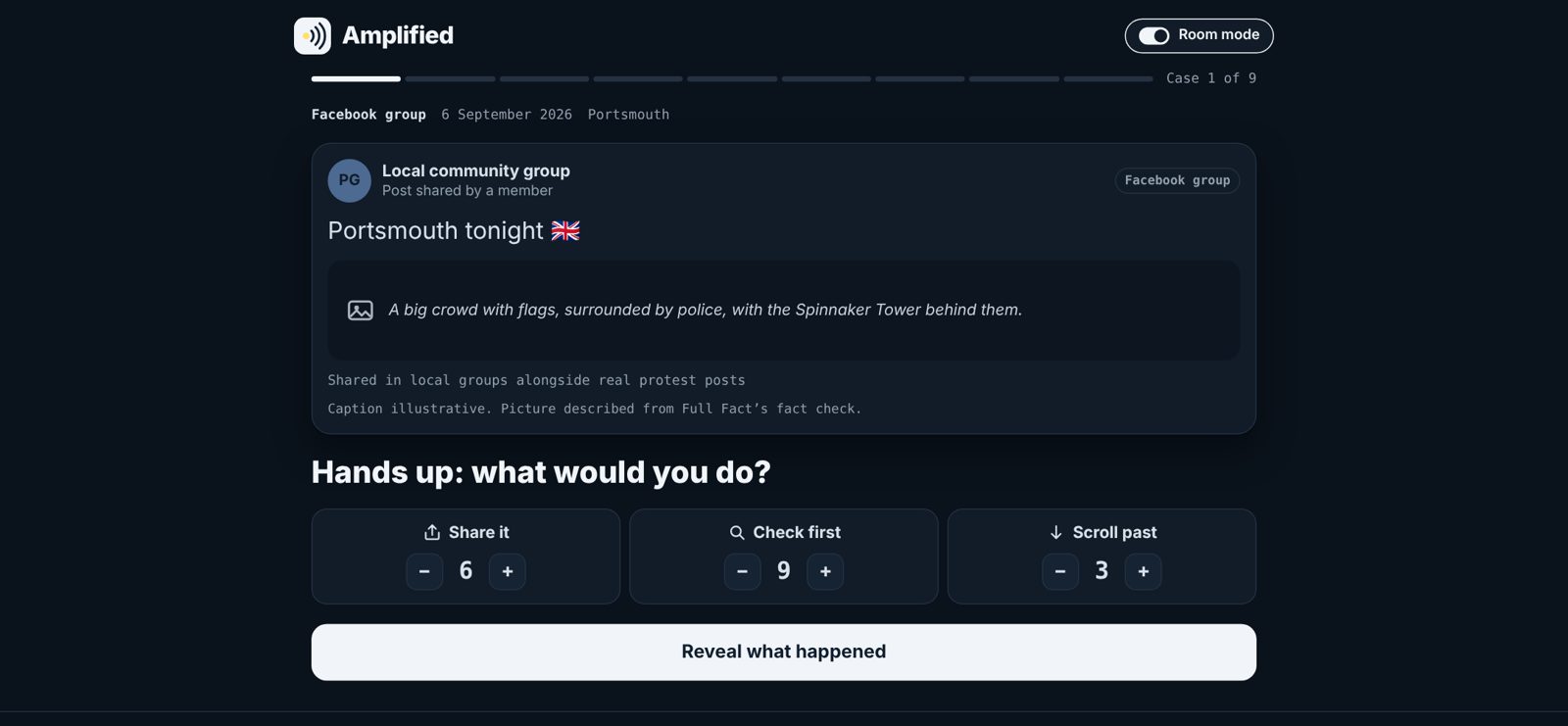
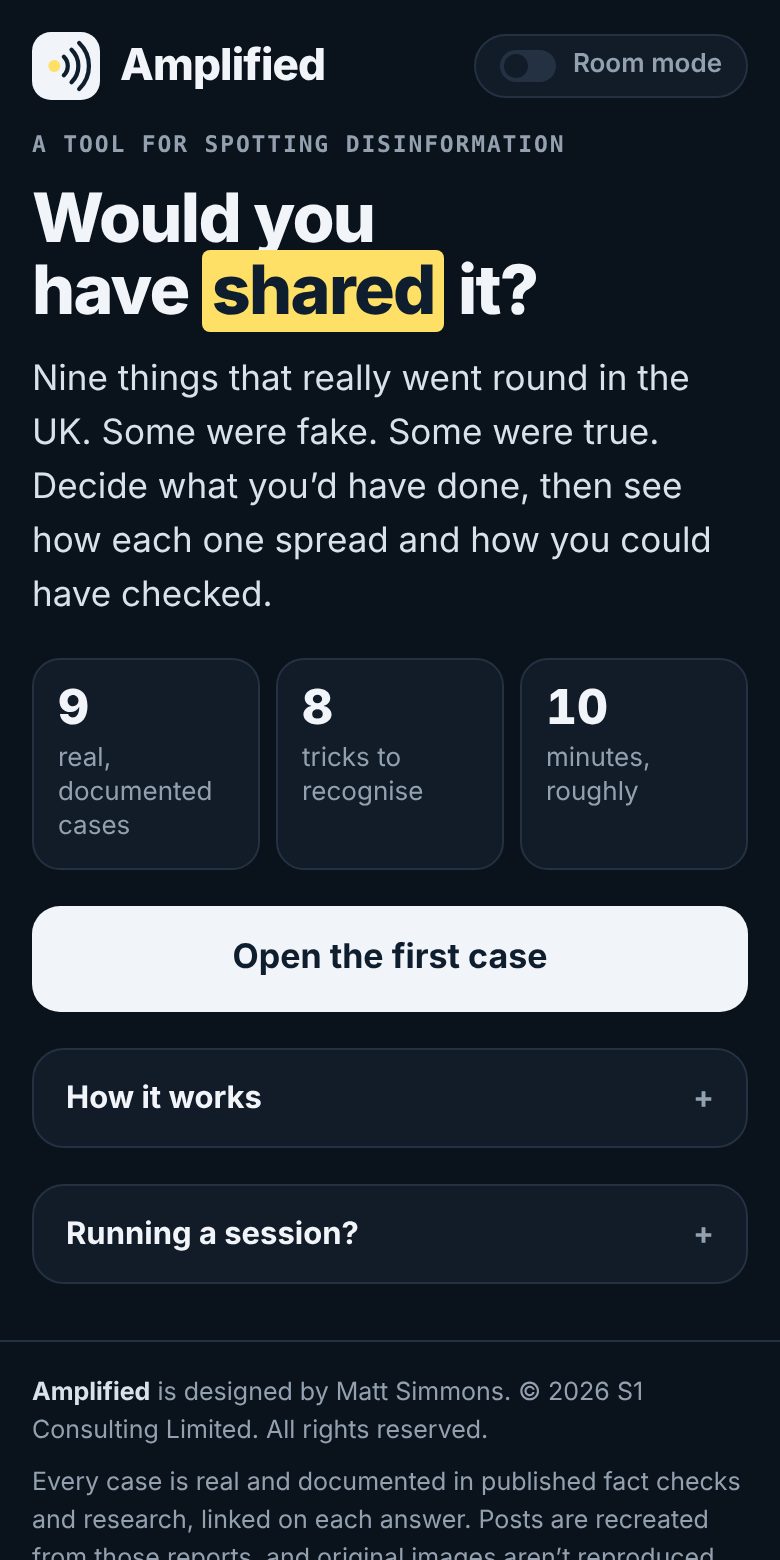
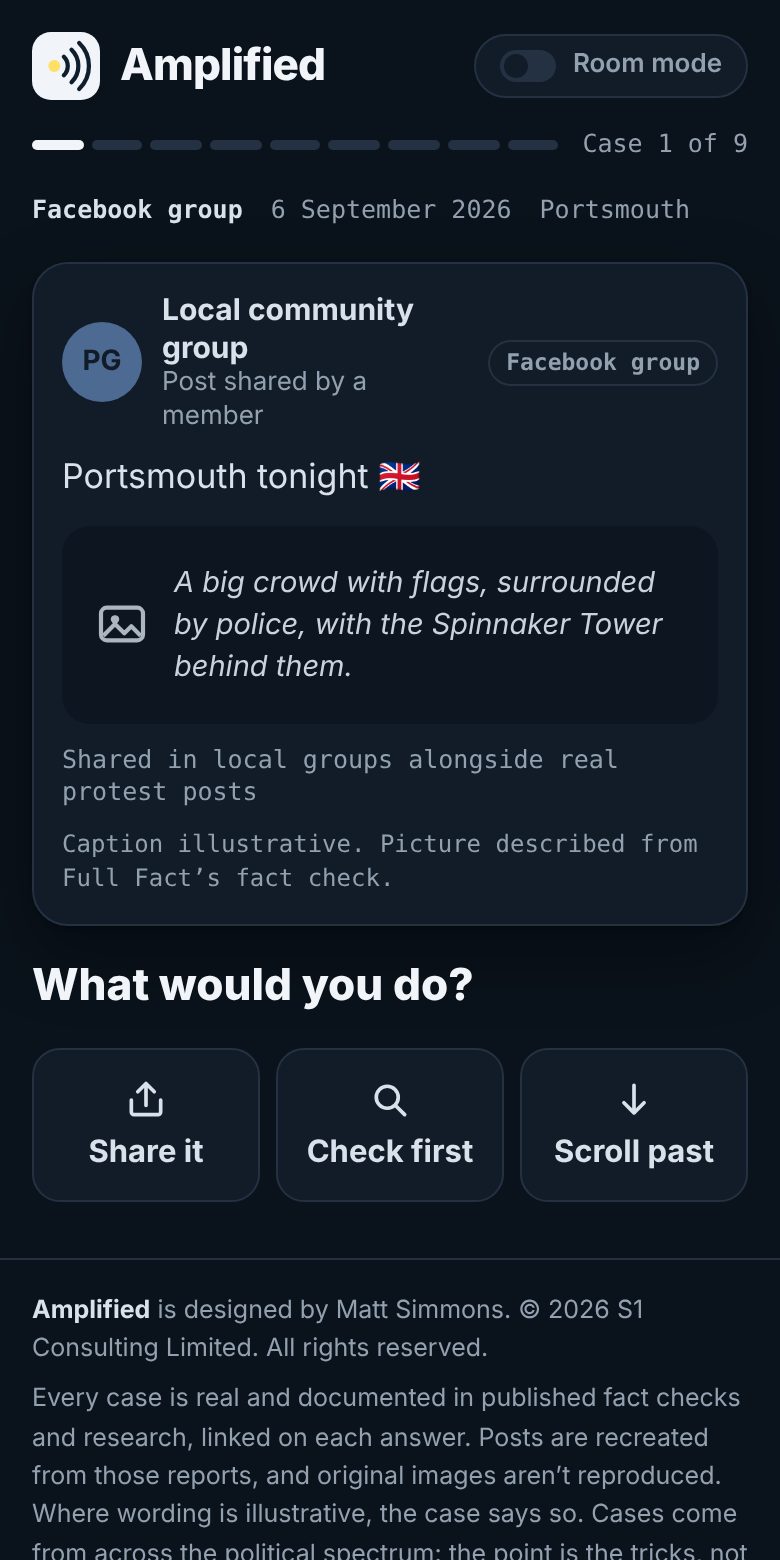
One real post at a time, on a projector or on phones. Everyone decides, then the case file opens. These screens show the start of a session, not the answers.
Why it is built this way
The cases are documented, varied and selected for their learning value. The point is not to tell people what to think. It is to make checking feel normal and useful.
Each case is based on a documented UK example and links to published evidence or fact checking.
That is deliberate. The lesson is to check first, not to assume everything is false.
The cases cover different political and social settings, including manipulation aimed at different sides of the political spectrum and foreign influence operations.
Participants are not made to feel foolish. People often share misleading posts because they mean well or want to help.
It follows the prebunking research from the University of Cambridge, which found that learning the tricks behind fake news helps people spot new examples they haven't seen before (Harvard Misinformation Review).
Seeing the room's choices challenges the idea that only other people get caught out.
Specific names, dates and details can make a claim feel credible.
An early version can travel widely before reliable checks catch up.
Strong emotion can make immediate sharing feel urgent.
A false authority, imitation or misattribution can disguise where a claim came from.
Fabricated or miscontextualised media can make a story look more convincing.
Invented profiles and coordinated accounts can create a false sense of agreement.
Divisive framing can turn disagreement into suspicion between groups.
A lack of evidence is presented as proof of a cover-up.
Stop. Investigate the source. Find better coverage. Trace it back.
This is the SIFT routine. Participants use it to move from an instinctive reaction to a more deliberate check.
Who it is for
Sessions are adapted to the people in the room and the questions they are working through. The cases are chosen to support thoughtful discussion, not to prescribe a political position.
Session format
Each session runs for 75 minutes, leaving time to talk through the cases and practise checking together.
| Activity | Time |
|---|---|
| Welcome and objectives | 8 min |
| Opening question and confidence check | 5 min |
| Nine Amplified cases | 10 min |
| Group discussion and techniques | 20 min |
| Practising the SIFT routine | 20 min |
| Reflection, evaluation and close | 12 min |
| Total proposed session | 75 min |
Format and timings can be agreed to suit the group.
Learning and evaluation
Amplified aims to help participants pause before sharing, recognise manipulation techniques, ask better questions about sources, distinguish popularity from reliability and feel more confident discussing uncertainty.
RAF veteran and founder of the Hampshire refugee charity Bridge to Unity. Amplified grew out of watching AI fakes and rumours spread through Portsmouth and Gosport in 2026, and seeing who got hurt.
More about MattBring Amplified to your organisation
Tell me about your group, who'd be in the room and what's been going on locally.
The enquiry form opens with Amplified already filled in. Costs and format are agreed with each group.